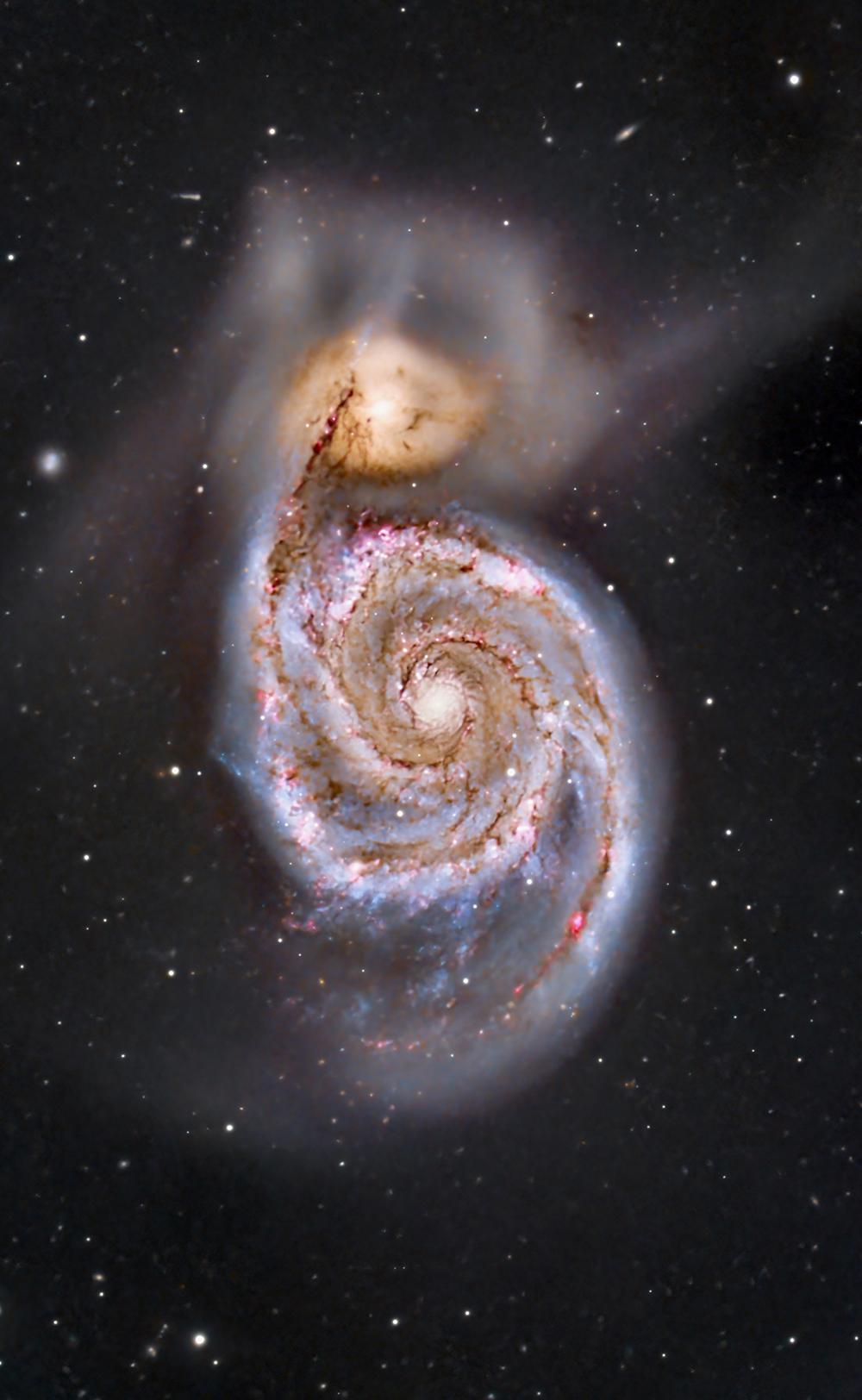
The Whirlpool Galaxy also known as Messier 51 might be the most popular galaxy to photograph. It is an interacting spiral galaxy in the constellation Canes Ventici close to the Big Dipper at a distance of 32 million light years away from earth. What you see in the picture is actually two galaxies interacting (colliding) and profoundly affecting each other.
To make this image I took 79 exposures with blue filter, 79 green, 91 red and 187 with luminance filter each with a duration of 3 minutes. In addition 86 exposures with Ha filter was taken each with a 5 minute duration. Also, calibration frames were obtained (Darks, Flats). In total 21.8 hours of LRGB and 7.2 hours Ha exposures. For this image I used the “galaxy rig”. Imaging was performed between March 19-24, 2022.
Preparations for a night imaging session
First you have to figure out if the night sky will be clear using different weather apps but this is always a gamble. Second you must know whether or not the moon might be a problem. If the moon is present you should preferably image with a narrowband filter with the telescope pointing away from the moon. Shooting with LRGB filters at full moon is a waste of time.
During daylight I assemble the gear at a place with good night sky visibility and point the mount due north toward Polaris. If the focus of the telescope and guide scope is off I do a rough focus adjustment during daylight. Shortly before astronomical darkness occur I go out to the telescope and start the ASIAIR computer which in turn activates the mount, camera and dew heaters. I remove the telescope caps and take a test shot to confirm that the telescope is in rough focus. Then I run the polar alignment routine to make sure that the mount is aligned to Polaris. When this is done I tell the computer to slew the telescope to the target for the night, in this case the Whirlpool Galaxy. Once centered on the object I may adjust the rotation of the camera to frame the object to my liking. Thereafter I start the guiding process making the guide scope and camera identify a suitable star to track. When this is done the telescope and main camera optimize focus automatically using the Electronic Auto Focuser (EAF). I then program the computer to take any number of exposures of any duration with any of the filters available. In this case on a moon free night I capture with the LRGB filters and 180 second duration exposures. If I have 6 hours of darkness I would take 3 hours with RGB filters and 3 hours with the luminance filter. And I would expose with the luminance filter when the object is highest in the sky (least impacted by our atmosphere), because all the details of the object are in the luminance data.
Many things can go wrong during a night imaging session. Clouds might roll in at any time. Airplanes passing will ruin the exposures but satellites usually don’t. Wind gusts can sabotage the session and cables attached can snug and break because of the rotating mount. A power outage definitely put an end to the session. Usually I stay until the first Light frames have been captured successfully and then head home.