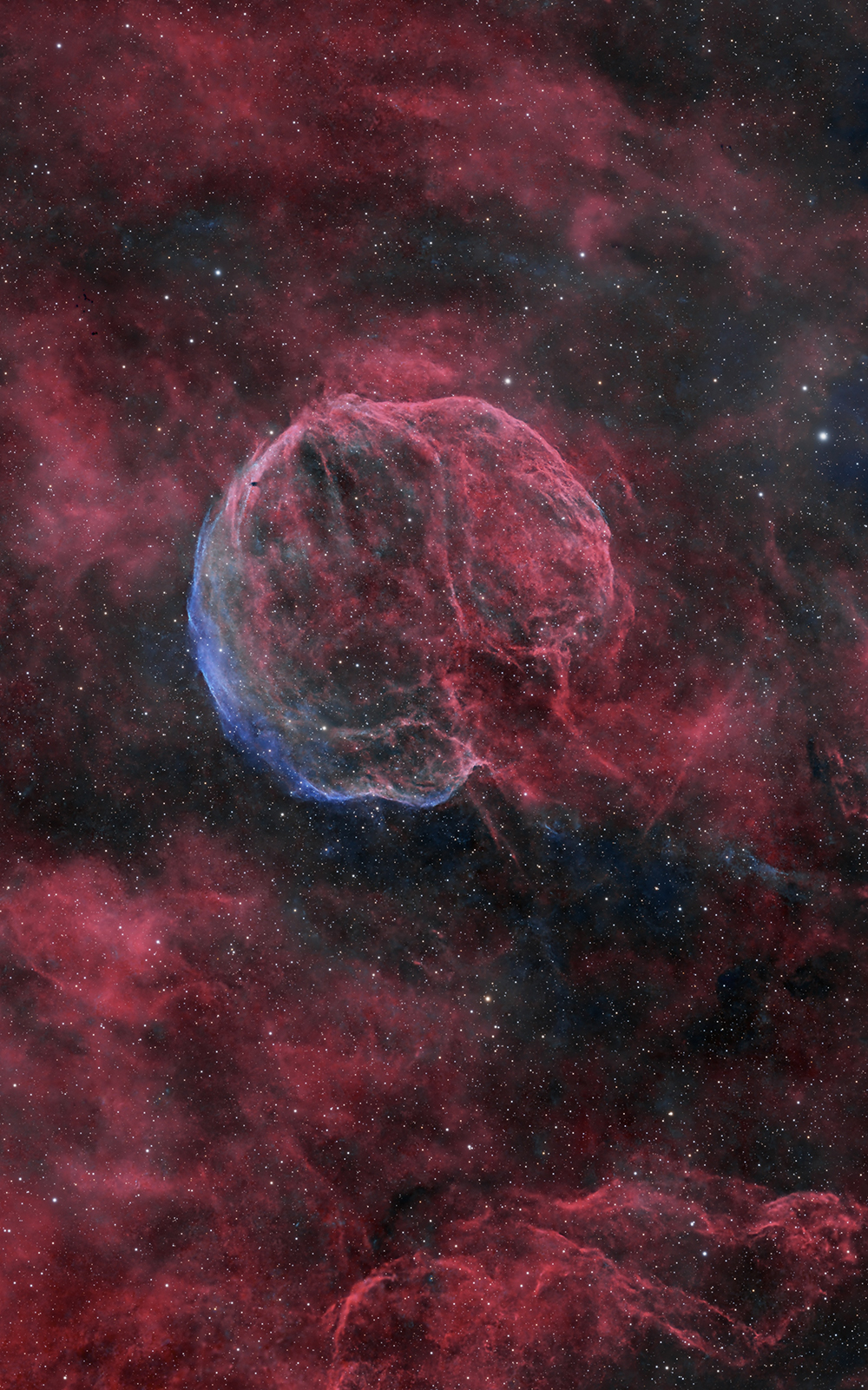
The Garlic Nebula or Abell 85 (catalogue name) is not a nebula but a supernova remnant located in the constellation Cassiopeia. A supernova is the colossal explosion of a star. One type, called a “core-collapse” supernova, occurs in the last stage in the life of massive stars that are at least eight times larger than our Sun.
This supernova is approximately 9 700 light years from Earth and the explosion is thought to have occurred about 10 000 years ago. If this is correct it would mean that the photons reaching my camera sensor were created some 300 years after the explosion. The cloud is rich of Hydrogen and Oxygen so I used Ha and Oiii filters capturing it. It is quite faint, originally discovered in 1950´s and correctly identified as a supernova in 1971.
Since it is a faint object I needed quite long exposure time to obtain this result, in total 25 hours of exposure with 300 second light frames with Ha and Oiii filters in equal numbers. Shooting faint objects in the night sky also requires dark skies, i.e. Bortle scale of 4 or less. Over the years I have noticed that the lights from our neighboring city is getting stronger and stronger. This is becoming a real issue especially when I photograph with the broadband filters that I use for e.g. Galaxies. In the future I will probably have to invest in narrowband filters with smaller band-with (3 nanometers instead of the 7 nanometers I’m currently using) to counteract the influence of light pollution. Such filters, however, are quite expensive. Or I could move to an uninhabited place… At the same time I’ve also noted that the number of Satellites in the night sky are increasing exponentially. Fortunately the software I’m using usually takes care of the Satellite-streaks in the light frames.