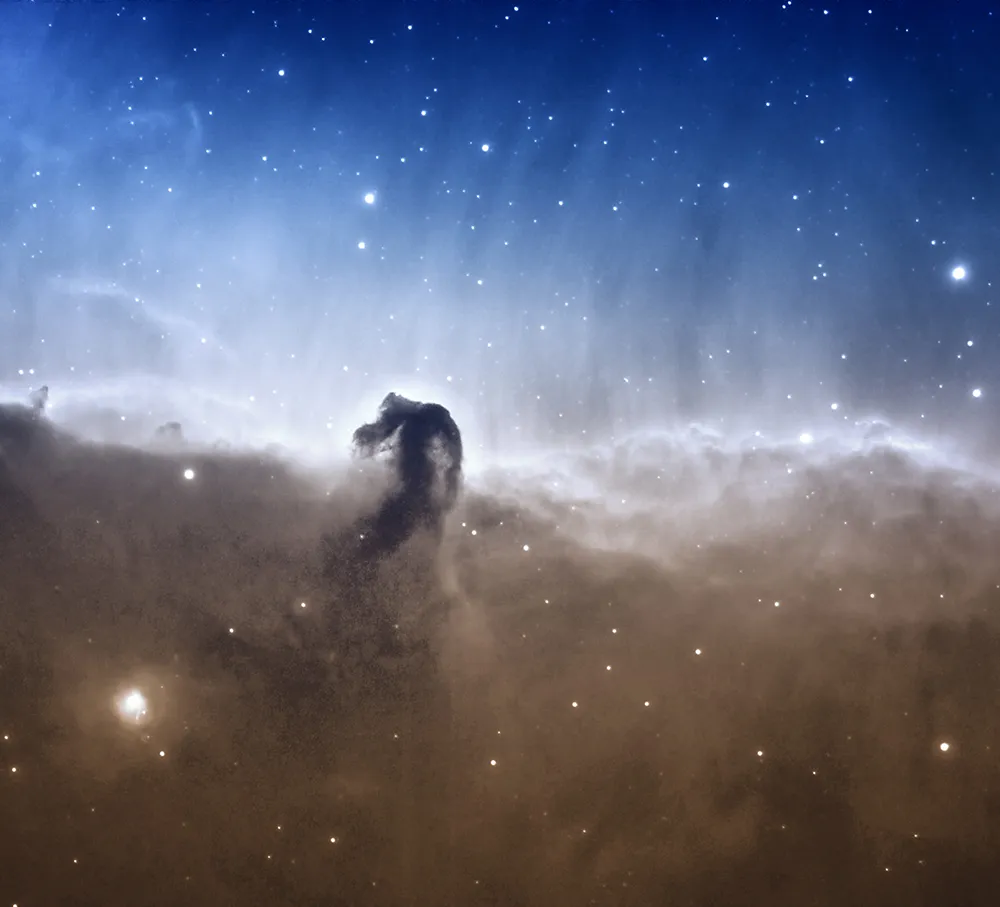
The Horsehead Nebula is a dark nebula located in the constellation Orion just south of the star Alnitak in Orion’s Belt (see below). It is part of a larger molecular cloud complex consisting mainly of ionised hydrogen gas. Magnetic fields channel the gases making streaks in the gas clouds against the background glow as shown in the image.
To capture this image I used the galaxy rig with my Celestron 8″ EdgeHD telescope and ZWO 2600MM camera. Between march 13-14, 2022 I took 32 x 5 min exposures using the Hydrogen alpha filter. To get color in the image I used Nik 6 Color Efex bi-color filter and Lightroom.
Orion constellation

Orion constellation with the belt and sword. The star Betelgeuse is expected to explode any day now within a 100 000 year timespan, an everyday likelihood actually higher than the chance of winning the highest price on Eurojackpot.
Orion, Running Man, Flame and Horsehead Nebulae

Zooming in on Orion’s belt and sword several gas clouds are revealed including the Orion Nebula which is visible to the naked eye under dark conditions. The Horsehead Nebula is located south to the most eastern star Alnitak in Orion’s Belt.
This picture was captured by Jan Lim and published 2021 in the Facebook Astrophotography group. Here he used a Samyang 135 mm lens with Nikon D700 camera to get this wide field image of the belt and sword of Orion “the Hunter”.
Flame and Horsehead Nebulae

Flame and Horsehead Nebulae even more zoomed in. A starless version that I captured 2022 with the Zenithstar 73 telescope, ZWO 2600MM camera and Ha, SII and Oiii filters. With this telescope compared to the EdgeHD the field of view is more wide. You can appreciate the complexity of this cloud complex named IC 434 that includes the Flame and Horsehead Nebulae.
ESA´s Euclid telescope capture of the Horsehead Nebula

The Euclid spacecraft consists of a 1.2 m-diameter telescope with cameras that was launched on July 1, 2023 from Cape Canaveral, Florida. It was developed by the European Space Agency (ESA) and the Euclid consortium and its location in space is about four times the distance between the Earth and the Moon. The main purpose is to explore the evolution of the “dark” universe whatever that means. This image of the Horsehead Nebula is one of the first captured by Euclid and recently published. The telescope captures an area of sky a hundred times larger than NASA´s James Webb Telescope.