
The Island of Antiparos in the Cyclades, Greece is simply fantastic. I have regularly visited this Island and our most recent trip took place this September to meet good friends, eat good food and relax.
Bringing the “astrophotography travel rig” (see Equipment page) is not that difficult but might require an extra bag and protecting sensitive equipment like the camera and lenses which I carry as hand luggage.
In a light pollution map the southern parts of the Island has Bortle Class 2 conditions, i.e. very dark and perfect for Milky Way (MW) photography. I wanted to include a typical Greek Church as foreground in the MW shot and found Agios Georgios to be the perfect place. When I came there after sunset I found a strong lamp lighting the Church making this composition impossible. A few meters away however the conditions for MW photography was optimal. I therefore decided to image the Church and MW separately making a composite photo placing the MW as it was positioned in the Church photo. A total of 25 images of MW each with a 2 min duration was stacked in PixInsight to make the most detailed MW shot I have taken thus far.
Bortle scale explained

The Bortle scale is a nine level numeric scale that measures the night sky brightness of a particular location. The scale ranges from Class 1, the darkest skies available on earth, through to Class 9, inner-city skies.
Picture from OPT Telescopic home page
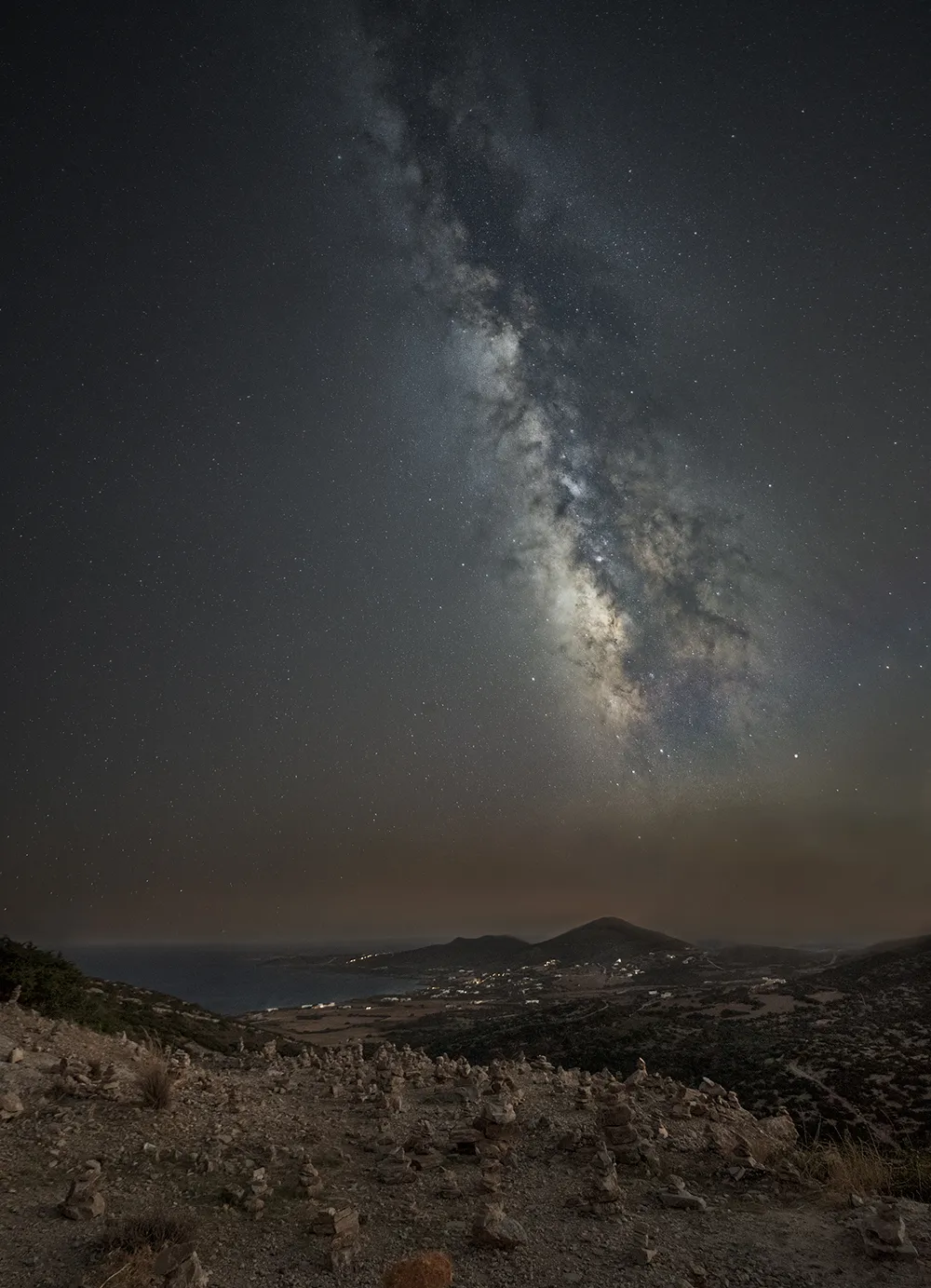
Milky Way at the Cave
Milky Way at Faneromeni beach
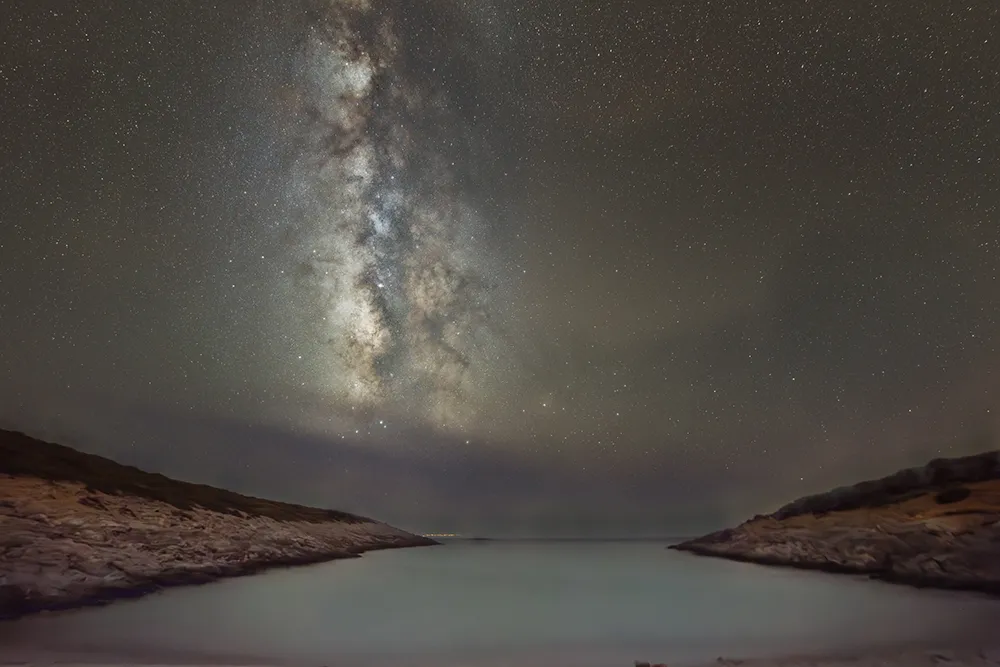
During my stay at Antiparos I had the time to capture the Milky Way also at the Cave entrance which is a high altitude location on the Island and at Faneromeni beach, both with the “travel rig”. On each occasion I captured and stacked 10-15 exposures of 60 second duration with the tracker for the Milky Way and a 60 second exposure without the tracker for the foreground. Finally I blended these images in Photoshop.