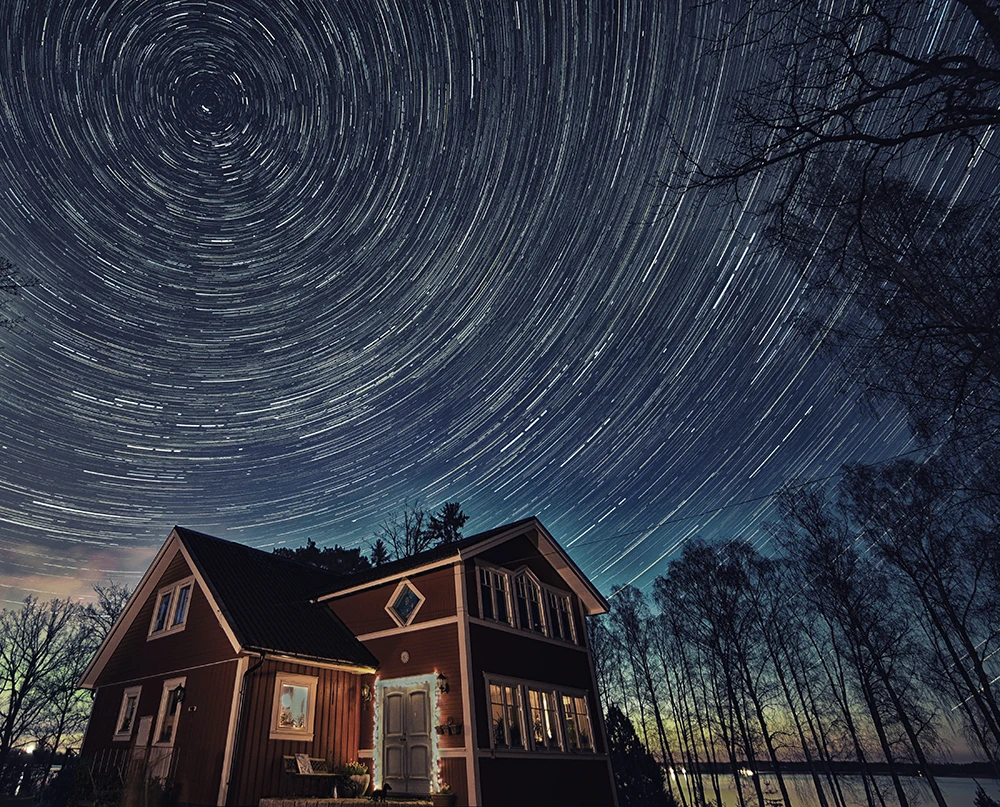
The earth is rotating around its axis causing the moon, planets and stars to move over the night sky faster than one might think. If you want to take a picture of the night sky with pinpoint stars the camera shutter speed has to be relatively short especially at longer focal lengths. With longer exposures the stars form streaks in the image. You can calculate the shutter speed in seconds needed to get pinpoint stars using the “500 rule”: Shutter speed = 500 / crop factor x focal length. For example, my Nikon D500 camera has an APS-C sensor with a crop factor of 1.6. I used a Samyang lens with 10 mm focal length. The longest exposure to avoid star trailing is thus 500 / 1.6 x 10 = approximately 30 seconds. This is useful to know if you for instance would like to image the Milky Way.
In this picture however I wanted to visualize the way the stars move in a circular pattern, all except the North Star “Polaris” which moves very little being situated at the north celestial pole. To make this picture I put my camera on a steady tripod with a wide lens (focal length 10 mm) and took 2 minutes exposures throughout the night. All these photos were then stacked in a free program called StarStax overlaying all star trails into one picture. In Photoshop I then combined (image blend) this star trail image with an image of our house (short exposure, you can see our dog Myra at the door) at the same camera position as for the long exposures.
I had to connect the camera to power because the camera battery wouldn’t have lasted all night. I also put a dew heater at the camera lens to prevent condensation that would have ruined the shots. Before taking the long exposures I turned off all lights inside and outside the house and went to bed eagerly waiting for the morning to come…