
The Pinwheel Galaxy also known as Messier 101 is a face-on spiral galaxy 21 million light years from earth in the constellation Ursa Major containing the Big Dipper.
I used the Celestron 8″ EdgeHD telescope for this image with two different cameras: ZWO ASI 183 MC for RGB color images (50 x 300 seconds) taken on 7-8 of April 2021 and ZWO ASI 2600 MM for luminance images (95 x 180 seconds) taken 1-2 of April 2022; total exposure time 9 hours. Calibration images (darks, flats, bias) were also taken to reduce noise and other artifacts in the final picture. Other equipment used were HEQ5 pro mount, ASIAIR plus and StellarMate computers, ZWO 120 mm guidecamera with guidescope.
ESA/Hubble image of Pinwheel Galaxy
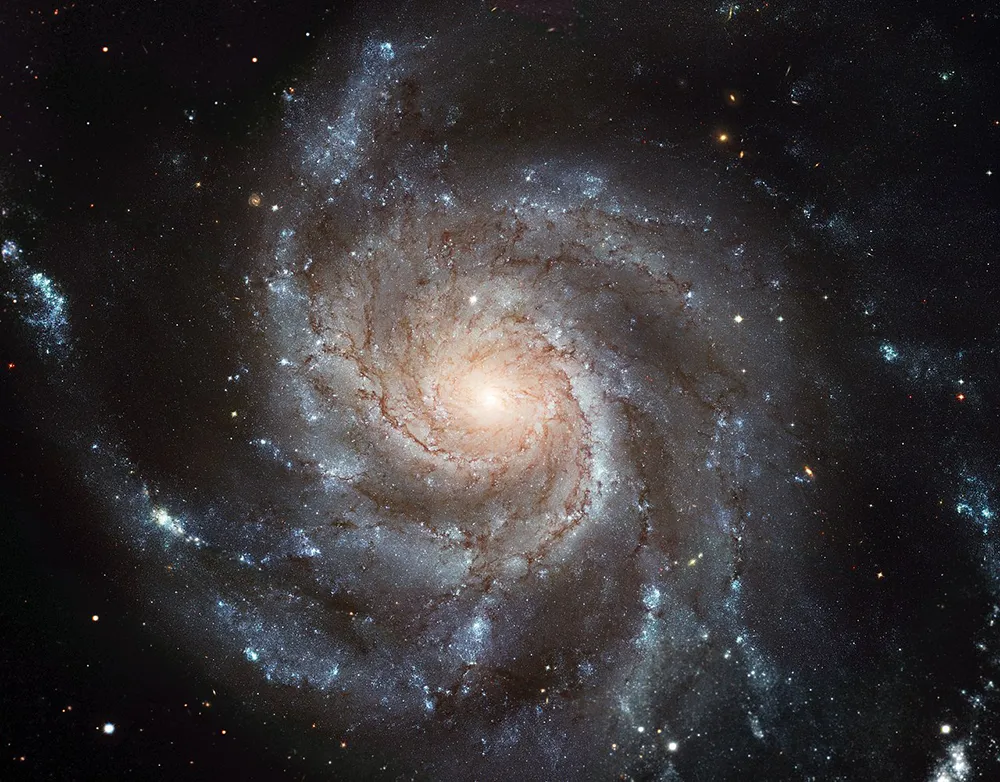
This galaxy was photographed by the Hubble telescope in 2006 and the image was composed of 51 individual exposures with an amazing final result. This is the “absolute reference” to compare with!
M 101 is a large galaxy about twice as wide as the Milky Way and contain about a trillion stars. The galaxy is relatively rich of ionized hydrogen regions (H II) that may give birth to thousands of stars over a period of several million years. In the end supernova explosions and strong stellar winds from the most massive stars in the resulting star cluster disperse the gases of the H II region leaving a cluster of stars which have formed.
Recently a supernova explosion was detected in this galaxy and this event was photographed by many amateur astrophotographers. Although we could see this event in May 2023 it actually occurred some 21 million years ago…
Pinwheel galaxy with supernova, May 2023

Close up images over 7 nights of the supernova

These two images were published in BBC Sky at Night Magazine and were taken by amateur astrophotographers showing a quite rare event of a supernova explosion that took place in the Pinwheel galaxy and was observed in May of 2023. The gear that Jane and Martin used to take these photographs is similar to mine. This supernova event was also captured by several Swedish astrophotographers but unfortunately not by me.