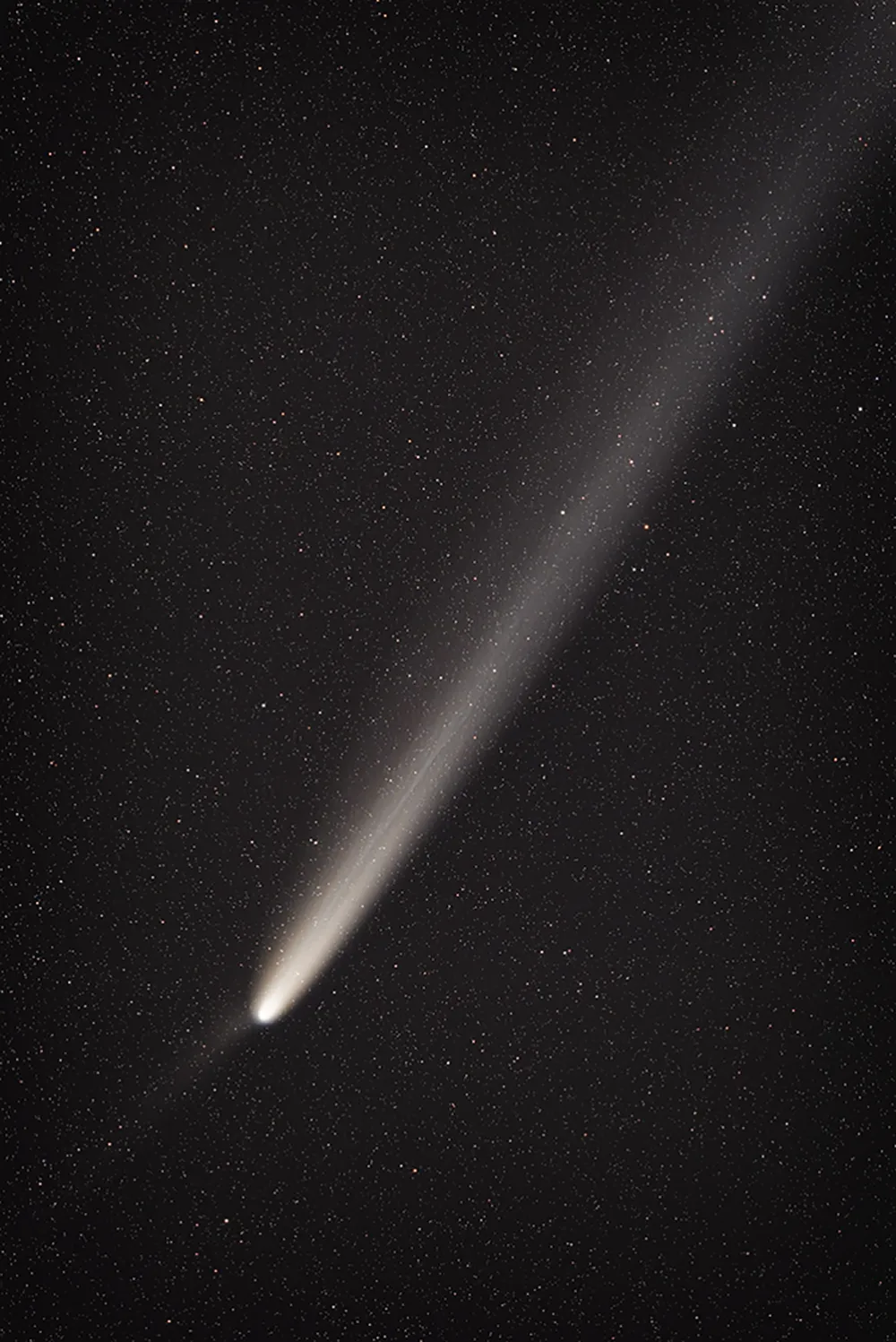
Comet C/2023 A3 Tsuchinshan-Atlas is a mass of dust, rock and ice which likely traveled from the outer reaches of our solar system, made its closest transit past the Sun on September 27 and came within approximately 70 million kilometers of Earth on October 12. During a short period of time it was visible to the naked eye under dark conditions making it the brightest comet in 27 years!
When a comet approaches the Sun, it gets warmer. Heat causes its ice to sublimate into gas, and these gases and dust become a glowing coma and tail that can extend millions of kilometers.
The solar wind strips ions off of the comet’s surface to create a second ion tail, which extends at a slightly different angle.
A third tail, the anti tail, is a protuberance from the comet that appears to point towards the Sun, often looking like a spike. It is actually part of the comet’s dust tail, and consists of larger (millimetre-sized) particles lagging behind the comet in its orbit. The antitail does not actually point sunwards, but results from a perspective effect when the comet is seen from a certain angle. Antitails are uncommon. Where present, they are usually most prominent when the Earth passes through, or close to, the plane of the comet’s orbit. The cometary dust, which lies in a thin sheet, is then seen edge-on.
Given its extremely long orbit, this ancient celestial traveler likely originated in the Oort Cloud, a large spherical shell of icy debris at the outer reaches of our solar system. C/2023 A3 Tsuchinshan-ATLAS was discovered in 2023, identified by observers at China’s Tsuchinshan—or “Purple Mountain”—Observatory and an ATLAS (Asteroid Terrestrial-impact Last Alert System) telescope in South Africa. It was officially named in honor of both observatories.
The image above was taken on October 22 between 19.15 and 20.15 pm in Sweden and specifically Norrtälje area under Bortle 4 conditions. The comet altitude was between 10 and 20 degrees above the horizon, i.e. very low and the atmosphere and light pollution had a severe impact on the quality of the images taken. I spent 50 minutes capturing the comet with the “Nebula rig” and LRGB filters (Lum 60 x 30 sec, R 20 x 30 sec, G 10 x 30 sec and B 10 x 30 sec). In the picture you can see some structure in the tail close to the coma as well as a faint anti tail.
Tsuchinshan-Atlas orbit

Single shot October 15

On October 15 the clouds disappeared and the Comet C/2023 A3 Tsuchinshan-Atlas was visible to the naked eye. I travelled to the eastern part of the lake Limmaren where I live. The moon was almost full which made the comet dimmer but this also made the foreground illuminated. I used Nikon D500 and Tamron 150-600@150 mm on a tripod, ISO 6400, f5.6 and 3 sec exposure. The image was processed in Lightroom to this final result.
October 17

Image taken on October 17 with my “Nebula rig”. To get this image I took 10 x 30 second shots with R, G and B filters each. At this time the comet was close to its brightest in the night sky, and the anti tail was prominent.
In order to process these images correctly I had to separate the comet and the stars in each capture and handle them separately because they move differently in the night sky. I could do all this in PixInsight, a fantastic astrophotography program for nerds…