
The large galaxy to the left in the image is catalogued as M 106 by Charles Messier. It is a spiral galaxy in the constellation Canes Venatici close to the Big Dipper (see below). M 106 is at a distance of about 25 million light years away from earth. In this image there are a vast number of distant galaxies. When you look closer many of the white dots that look like stars are actually galaxies. When I showed this image to my friends on the Facebook group “Astrophotography Sweden” one member pointed out that one of the galaxies actually visible in the image is located some 3.6 billion light years away (encircled in the zoomed-in image below). Distances in our universe can be measured using a method called redshift which is too complicated for me to explain (= I don’t understand…).
This shot was made with the “galaxy rig” using the 8″ EdgeHD telescope. 75 exposures with a duration of 180 seconds were taken with the luminance filter and 25 exposures with R, G and B filters each, total exposure 450 minutes.
Zoomed in distant galaxies

One of the encircled galaxies in this zoomed-in image is supposed to be located about 3.6 billion light years away. According to the Big Bang theory and observations made by astronomers, the universe is estimated to be around 13.6 billion years old. Recent observations made by the James Web Space Telescope (JWST) cast doubts on these estimates, however.
Canes Venatici region
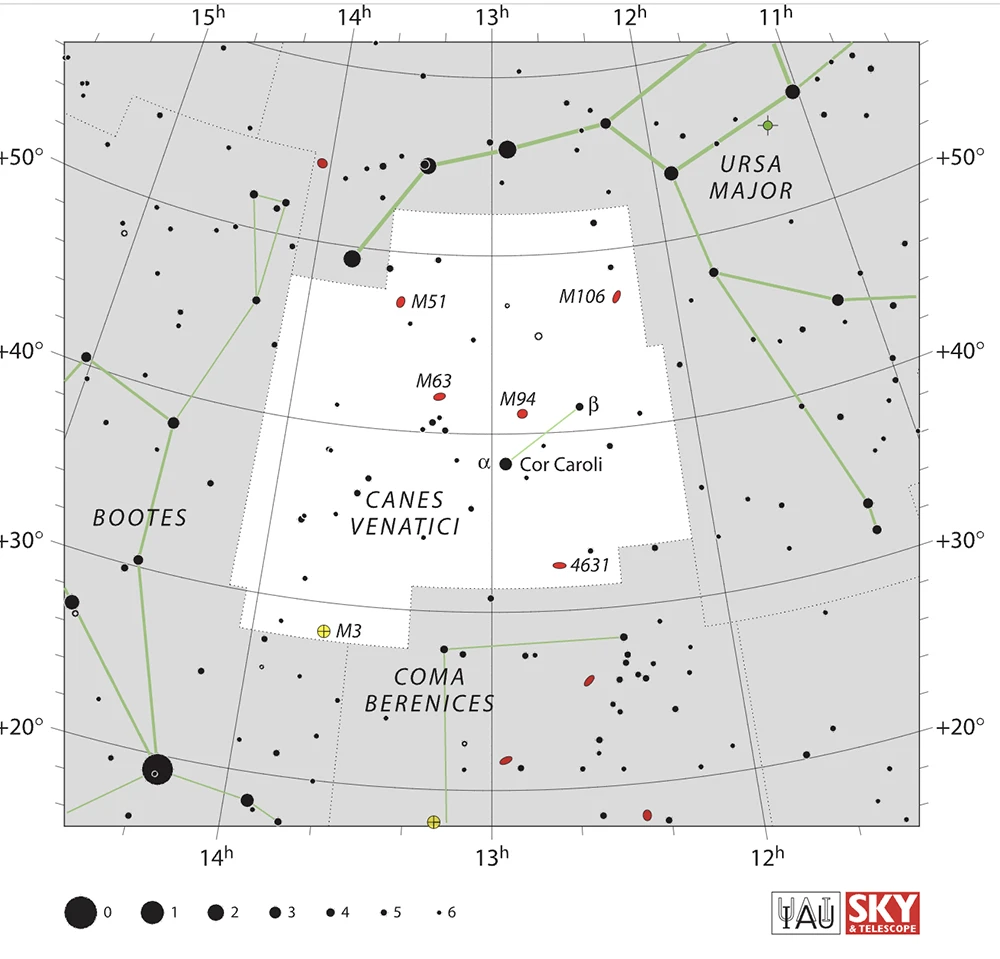
Canes Venatici constellation close to the Big Dipper (Ursa Major) in the night sky with a large number of galaxies including M 106 and Whirlpool Galaxy among others.
By IAU and Sky & Telescope magazine (Roger Sinnott & Rick Fienberg) – [1], CC BY 3.0, https://commons.wikimedia.org/w/index.php?curid=15406242