
Andromeda is our nearest major galaxy neighbor located about 2.5 million light years from earth. The Milky Way and Andromeda galaxies are expected to collide in about 4-5 billion years forming a giant elliptical galaxy. In this image you can also see two satellite galaxies – M 32 on the left and M 110 on the right of the Andromeda nucleus, both interacting with Andromeda.
For this image of Andromeda I used the “nebula rig”. The RedCat 51 telescope with a focal length of 250 mm is perfect for this galaxy. In total the exposure time was almost 18 hours (luminance 56 x 5 min, RGB 103 x 3 min and Ha 96 x 5 min).
Image from Stellarium app
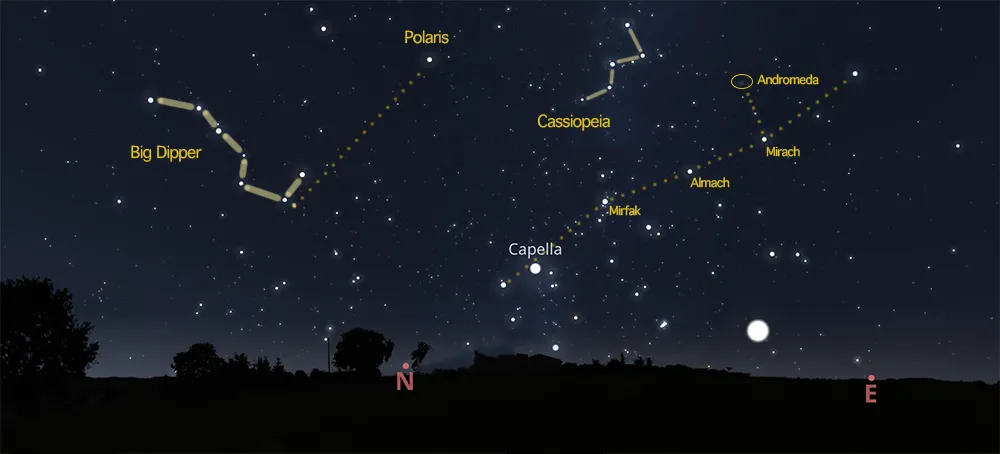
Andromeda Galaxy is visible to the naked eye under dark conditions but you have to leave the city lights to observe it. With binoculars you can clearly see that the light from the galaxy is more diffuse than a star. But how do you navigate in the night sky? I think the best way is to get an app to your smartphone and I could recommend Stellarium at present. This app does a good job identifying what you’re looking at. The picture above is from Stellarium and I´ve highlighted Big Dipper and Cassiopeia. From Big Dipper you can find Polaris (North Star) via an imaginary line upwards drawn from the back of the wagon. In Cassiopeia the upper V of the W points towards Andromeda Galaxy.

This galaxy is larger in the sky than one might think. It is actually as large as the full moon x 5 or 6 put side to side as illustrated here. I didn’t know this when I first tried to image this galaxy. On my first attempt to image Andromeda Galaxy I used a telescope with a focal length of 1000 mm and was surprised to only see the center of the galaxy in the picture.
My first attempt

My second attempt
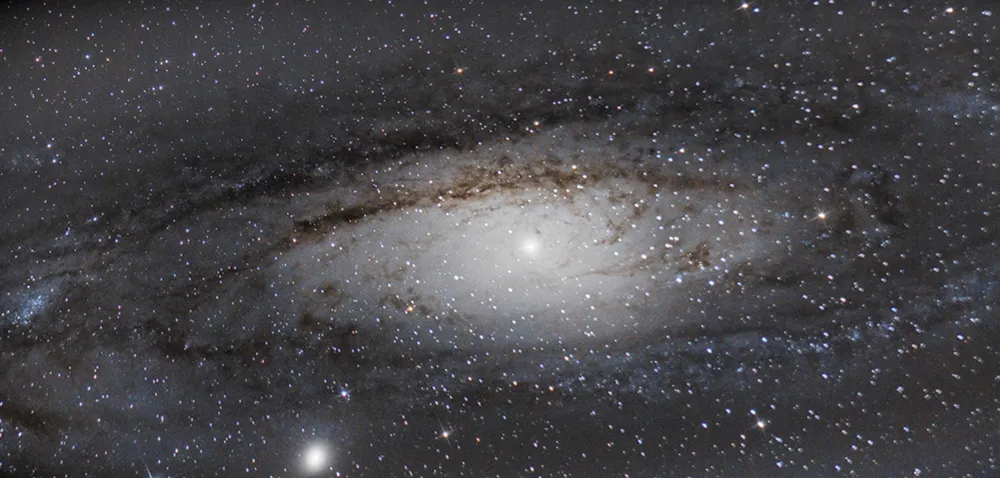
My third attempt
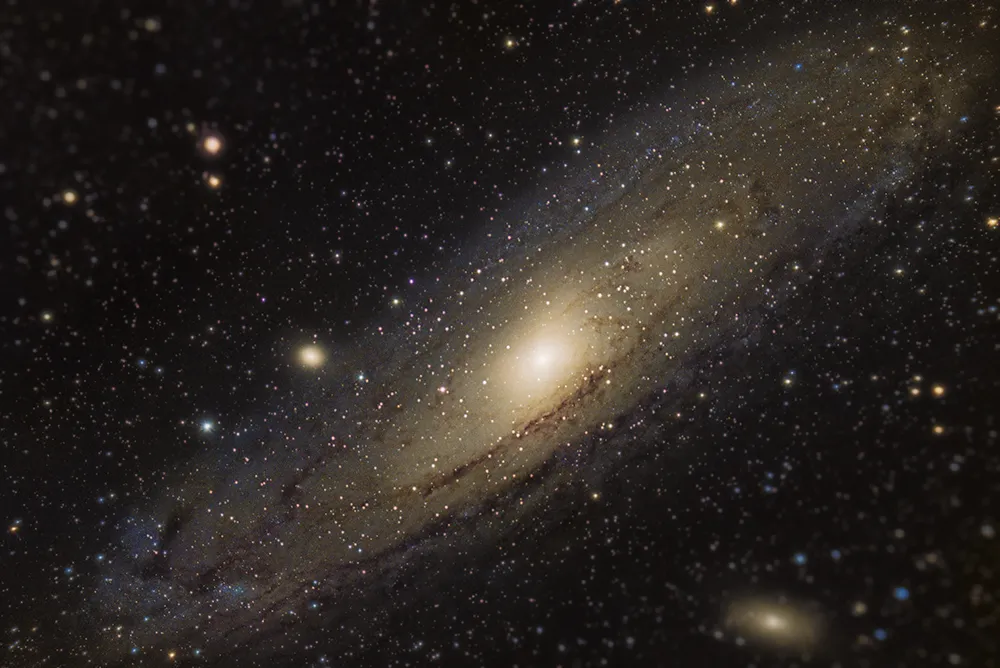
I’ve imaged the Andromeda Galaxy on several occasions with increasing levels of success if I may say so. Andromeda was really the first night sky object I wanted to photograph being our closest galaxy neighbor. In the beginning I didn’t realize how big this galaxy was in the telescope. I still have a lot to learn in the field of astrophotography.